

Project Spotlight
Many SEAOCC members have been responsible for the design of complex, innovative, and award-winning projects in California and around the globe. Read on to find out about the most recent SEAOCC Excellence in Structural Engineering Award winning projects and other innovative projects designed by local firms!
2026 Project Spolight
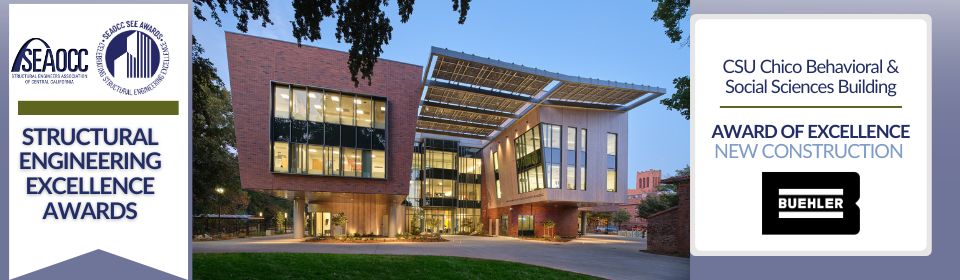
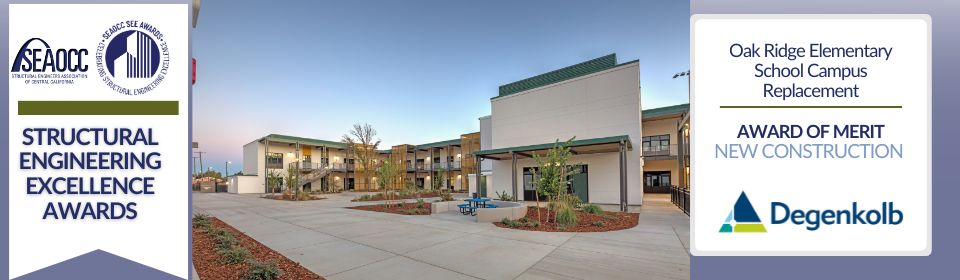
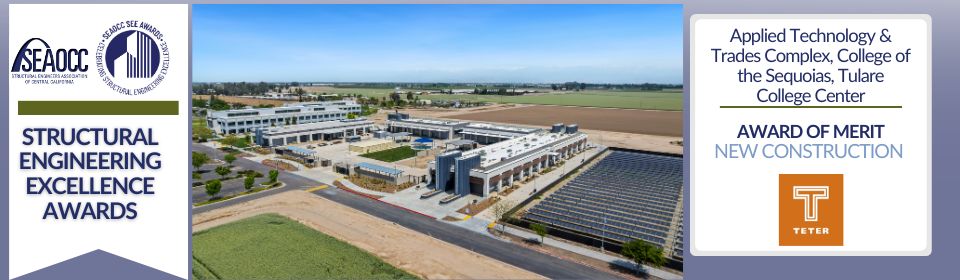
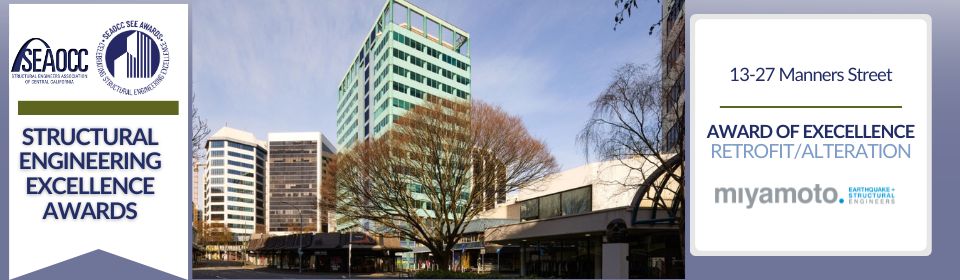
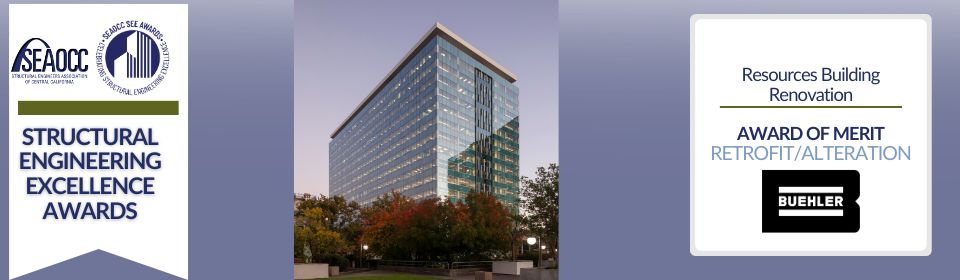
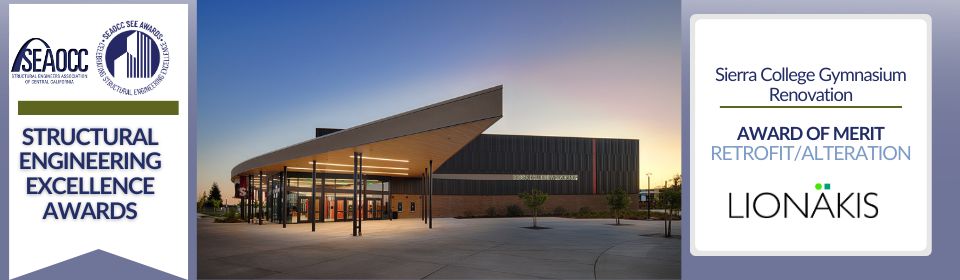
2024 SEAOCC EXCELLENCE IN STRUCTURAL ENGINEERING AWARDS WINNER
New Construction (Large)- Award of Excellence
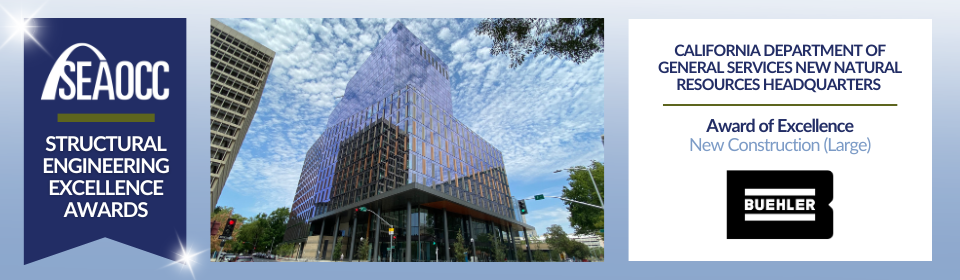
The California Department of General Services New Natural Resources Headquarters is a modern addition to
the heart of downtown Sacramento. With 22 stories rising 350 feet above-ground (838,000 SF), the facility
features office, assembly, storage, building support, parking, retail, and commercial food service spaces.
The new $540M tower houses approximately 3,450 employees with staff from various State of California
departments. The tower achieves an ultra-low Energy-Use Intensity via the implementation of radiant floor
heating, chilled beams, reclaimed wood from the Paradise fire, and a high-performance façade. Other
sustainable features include abundant natural daylighting, solar shading to minimize glare, filtered outside air,
and the building’s reclaimed water system, which allows the residents of the tower to use 50% less water than
a comparable office building. The building has been certified LEED Platinum and achieves Net-Zero Energy
by operating on 100% solar energy supplied through a new type of agreement with the Sacramento Municipal
Utility District. Also included in the project was renovation and repair of the historic Heilbron House located on
site; deterioration of the historic mansion was remediated and extensive exterior improvements were made.
Buehler’s David Hutchinson, SE, was the Structural Engineer of Record and lead structural designer for the
project. The tower structure is steel-framed beams and columns supported on continuous flight auger piles;
transfer beams facilitate transitions to the concrete podium at lower levels. The lateral-force-resisting system
is buckling-restrained braced (BRB) frames that required a performance-based design due to the height and
complexity of the structure. The BRB frames are located adjacent to interior walls at building core areas,
allowing for brace-free interior office spaces and perimeter exterior walls. The ground floor two-way flat
slab serves as both a structural diaphragm to distribute seismic forces to perimeter walls as well as a support
element for major electrical and IT equipment infrastructure.
2024 SEAOCC EXCELLENCE IN STRUCTURAL ENGINEERING AWARDS WINNER
New Construction (Medium)- Award of Excellence
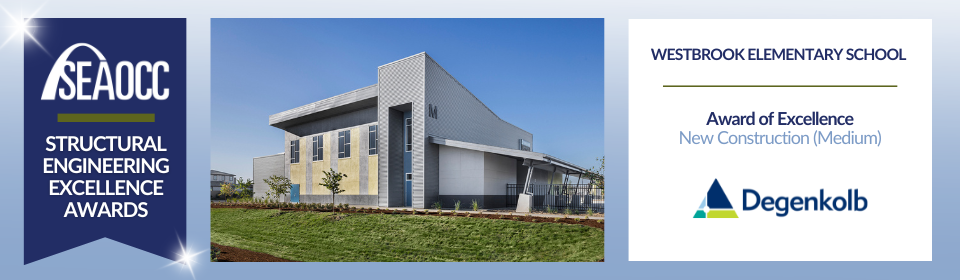
Degenkolb provided structural engineering for the new 52,000-square-foot
Westbrook Elementary School for Roseville City School District. Located on a 12-acre site,
this new 800-student campus consists of seven buildings, including four classroom
buildings, one kindergarten building, one administration and library building, and a multi-
purpose building. Our design-build team delivered a full design from schematic design
through DSA submittal in approximately 4 months and obtained DSA approval less than a
year after we were awarded the project. The project also faced a significant design change
when the initial cost estimate exceeded the owner’s budget. Our office provided a number of
design alternatives to reduce the cost and ultimately got the project within the owner’s
budget. All buildings are wood-framed with a lateral resisting system consisting of wood
shear walls, which is very cost effective. The structures utilized a modular framing system,
which allowed the contractor to expedite construction by framing walls off the side while
foundation work was being done. The wood framing also has a low carbon footprint which
aligned with the architect’s plan for a sustainable campus. The tall walls of the Multi-
Purpose Room provided several challenges with the wood construction. Engineered lumber
was used for tall wall studs where solid-sawn lumber was not a feasible option.
Additionally, we used vertical I-joists at a tall alcove to provide lateral stiffness at narrow
wall piers. In the case of this project, structural engineering excellence was demonstrated
within project planning and logistics rather than technical demands. We delivered a
successful project to Roseville City School District on time and within their budget
expectations.
2024 SEAOCC EXCELLENCE IN STRUCTURAL ENGINEERING AWARDS WINNER
New Construction (Small)- Award of Excellence
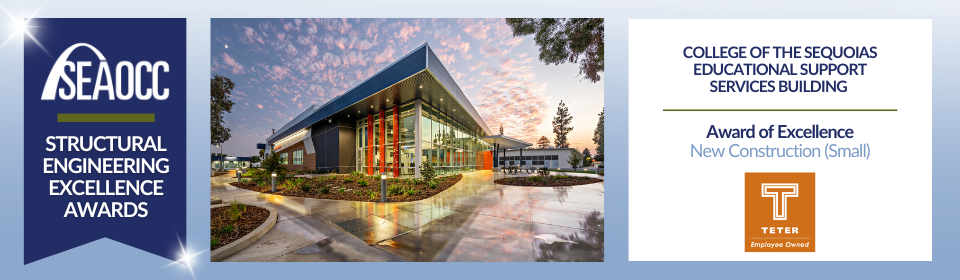
The most prominent corner of College of the Sequoias' Visalia Campus
received a much-needed upgrade, breathing new life into a visible part of the campus by
improving functionalities and aesthetic appeal. Structural Engineers designed a distinctive
steel brace frame lateral force-resisting system encircling the building perimeter, offering
flexibility for the owner's programming requirements while honoring the Architect's vision
for structural articulation. The versatile space features clear-span interior conditions,
enabling immediate use and seamless adaptation for future programs. This innovative
system enhances functionality and boasts visual appeal, with exposed brace frame
connections and sleek round HSS columns contributing to a cleaner look. An open web steel
joist vertical force-resisting system enables extended spans without imposing visual weight
on the exposed roof structure, ensuring structural integrity and architectural elegance and
complimenting the clean design. Additional structural engineering complexities include
framing the east exterior wall with varying angles, coordinating roof drain and sprinkler
piping through structural steel elements, and concealing roof drain piping within 'fake'
columns. A State-of-the-art variable refrigerant flow mechanical system increases energy
efficiency and long-term cost savings. Environmental design considerations include
maximizing indirect light exposure and capitalizing on the site's scenic views. The interior
comprises collaborative learning environments with integrated furniture and technology
systems. An exterior entry plaza serves as a public gathering space and entrance to the
campus core. Key TETER Team Members: Eric Bailey, SE, PE - Structural Engineer of
Record Megan Chang, SE, PE - Sr. Structural Project Manager / Structural Engineer Luis
Valtierra, EIT - Sr. Structural Engineer-In-Training Bryan Glass, PE, RCDD - Electrical
Engineer of Record Patrick Shaw, PE - Electrical Engineer Sophia Nyberg, EIT - Mechanical
Project Manager Vivek Harris - Project Manager / Sr. Educational Planner Jamie Hickman -
Architect of Record Key External Consultants: Net Positive Consulting Engineering -
Mechanical EORFTF Engineering - Roof Trusses Structural EORQK, Inc - Civil EOR
2024 SEAOCC EXCELLENCE IN STRUCTURAL ENGINEERING AWARDS WINNER
Historic Preservation- Award of Excellence

Originally built in 1914 to serve as the headquarters for the California
Fruit Exchange, the California Fruit Building was the tallest building west of the Mississippi
River at 10 stories and 135 feet tall. In 2021, the newly renovated Fruit Building reopened
as a Hilton-branded hotel named The Exchange Sacramento. Located in the heart of
downtown Sacramento, The Exchange is less than a mile away from the State Capitol,
Golden One Center and the Old Sacramento Waterfront District. Before what ultimately
became the final design for this adaptive reuse, the owner had been approached by other
structural engineers with different seismic retrofit solutions. These, however, did not meet
their need for a cost-effective, creative solution. Of import to this project was a design that
would preserve the historic fabric of this early 20th century building. Miyamoto’s design
added fluid viscous dampers at the ground floor to reduce the building’s soft-story response
to earthquakes and reduce inelastic demands on the existing non-ductile concrete framing.
The design also stiffened the tenth-floor columns with steel jackets to counter the
disproportionately tall penthouse level.
2024 SEAOCC EXCELLENCE IN STRUCTURAL ENGINEERING AWARDS WINNER
Retrofit Alteration- Award of Excellence

As one of Sacramento’s oldest and largest architecture firms, Lionakis
sought a new office space that embodied their vision to consolidate their 150-person
Sacramento office from three buildings into a single location. Fortunately, the former
Weaver Tractor Showroom across the street from their midtown location perfectly fit their
needs while offering unique design opportunities for growth and in-person collaboration
post COVID. The 1940s building boasts a rich history and architectural significance that
became a central theme for Lionakis during design. Designers took a bold approach,
removing most of the dropped ceiling in the vast 40,000-square-foot space to reveal
beautiful bowstring trusses, wood-formed concrete, and the pièce de resistance: a 100-foot
span arch truss towering over the main workspace. The original structure consisted of four
barrel-roofs and a flat roof, which had no connection between them other than the shared
walls that support them. The renovation addressed this by adding plywood sheathing
throughout and provided continuity by tying the roofs together with straps, steel angles,
and the use of sub-diaphragms. For earthquake safety, the existing concrete frame was
fortified with a combination of masonry shear walls and steel brace frames. The added
masonry infill walls – which were constructed in stack bond layout instead of the usual
running bond pattern – seamlessly blend with the historic architecture, while the steel
braces provide a modern, industrial aesthetic. The project team prioritized retaining existing
elements when possible – such as the original concrete flooring – retrofitting the building to
ensure safety and renovating the building to meet the needs of its future inhabitants. This
project exemplifies innovative structural engineering within workplace design. It
successfully transforms a historic building into a modern office space, celebrating the
materials of the past while ensuring adaptability and longevity for the future.
2024 SEAOCC EXCELLENCE IN STRUCTURAL ENGINEERING AWARDS WINNER
Retrofit Alteration- Merit Awards
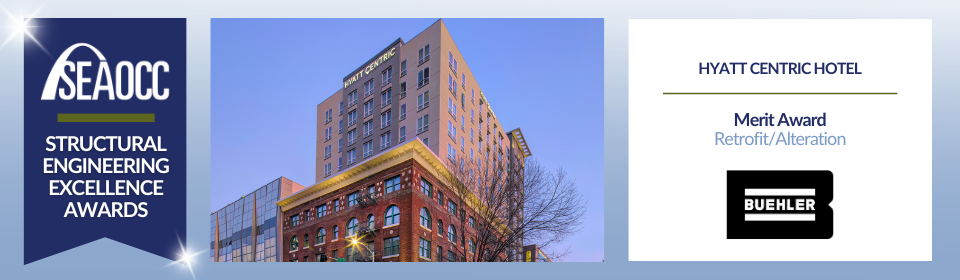
The historic Marshall Hotel got its start as the Hotel Clayton in 1911. At the time, this predecessor hotel was a
regional attraction for the jazz music genre drawing in big name performers to the area such as Billie Holiday,
Louis Armstrong, and Cab Calloway. This renovation project reconstructed the five-story unreinforced
masonry structure and transformed it into an 11-story steel-framed hotel. As a nod to its history, the historic
brick walls remained in place and the historic facade was integrated into the new hotel. The facade was
stabilized with 60-ft-tall steel trusses to allow the main portion of the existing structure to be demolished.
Within the preserved facade, the new structure consists of conventional steel construction up to the sixth
floor, and then transitions to light-gauge steel bearing walls for the upper five stories. The lateral system
consists of full-height buckling-restrained braced frames, bringing this century-old hotel into the modern era
while maintaining its old-world charm.
2024 SEAOCC EXCELLENCE IN STRUCTURAL ENGINEERING AWARDS WINNER
New Construction- Merit Awards
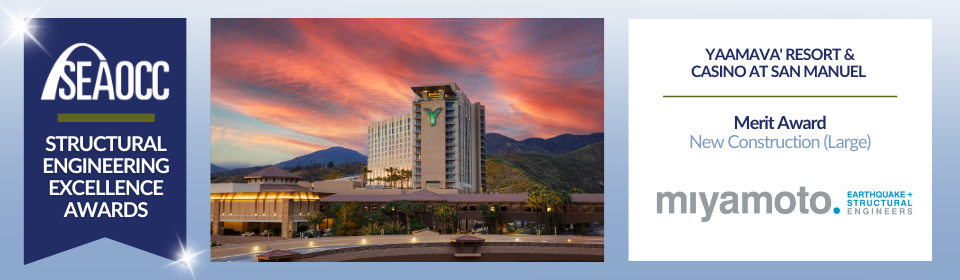
The Yaamava’ Resort & Casino is a $760-million expansion that added a
new hotel tower, casino and gaming area, and entertainment venue with office and retail
space to the existing casino, which opened its doors in 1986 as a bingo hall. Miyamoto faced
two main challenges. One was to provide smooth and visitor-friendly connections between
the existing casino, new casino and new hotel tower at various floor access points over
seismic expansion joints. Another challenge was to develop a seismic design and solution
with enhanced seismic performance to address the strong ground motion that could
generate from the San Andreas Fault (around 50 feet away). To meet both project budget
and schedule considerations, the solution had to be creative and efficient. The new, 17-
story, 432-room hotel consists of three concrete core walls with post-tensioned slabs. The
new casino is a three-story, 70-foot-tall, steel-moment-frame structure on top of one story
of basement parking with typical column grids of 60 feet. The new entertainment venue has
3,000 seats and 53,000 square feet of area over 50,000 square feet of below-grade parking.
The lateral force resisting systems consist of steel buckling-restrained brace frames for the
superstructure and concrete shear walls at the basement.
2023 SEAOCC EXCELLENCE IN STRUCTURAL ENGINEERING AWARDS WINNER
New Construction - Award of Excellence
 Design Firm:
RW Consulting Engineers, Inc.
Project:
South Valley Middle School Campus Replacement
The South Valley Middle School Campus is in Gilroy, CA. Gilroy Unified School district desired to replace several aging classroom buildings with seven new classroom buildings while maintaining school operations. The district was looking for high quality sustainable structures that would not only meet their program needs, but also have a lower cost than traditional site-built classroom structures. The design team, in conjunction with the contractor, developed a modular system capable of being constructed off-site while maintaining unique design features not found with typical modular construction. The modular components allow for simple reconfiguration of structural elements offering future flexibility in how the buildings are utilized at a relatively low cost.
The structural system utilizes a steel skeleton comprised of traditional and readily available structural shapes. Steel trusses and tube columns supporting metal deck roof planes provide the primary gravity system. The primary enclosure and lateral system consists of panelized walls constructed with metal studs sheathed with wood structural panels.
All components and wall panels were shop fabricated with high efficiency and tight tolerances resulting in consistent components. The steel skeleton works in tandem with the panelized wall system to create an efficient building that can be erected in a very short timeframe compared to traditional site-built construction.
Through efficient design and continued coordination with the shop fabrication process, material tonnage was kept to a minimum. The low structure mass combined with wood structural panel shearwalls resulted in a highly ductile lateral system with a reduced demand on the supporting foundation thereby reducing concrete volume.
Shop fabrication was performed concurrently with site work, underground utilities, and foundation construction. Together with Aedis Architects and Flint buildings, the sequencing of construction was taken into consideration during design to ensure the project met the desired schedule. This project has provided an extended life to an existing campus for the City of Gilroy to enjoy for years to come.
2023 SEAOCC EXCELLENCE IN STRUCTURAL ENGINEERING AWARDS WINNER
New Construction - Award of Merit
 Design Firm:
Degenkolb Engineers
Project:
Del Campo High School, New Science Building
San Juan Unified School District asked for a new signature building to welcome visitors to Del Campo High School. The campus was originally constructed in 1964 and has not had any significant modernizations or new construction added since that time. Our design-build team was challenged to deliver this new building, from project award to occupancy, in approximately 27 months. The progressive design-build delivery of this project meant all design team members, as well as the general contractor, were on board at the beginning. As a team, we worked closely with one another to develop an efficient design to maximize the budget for architectural programming and design features.
The new, 35,000 square foot building is situated at the front of the campus and serves as a focal point upon entry. A two-story classroom wing houses science lecture and laboratory spaces, and a high-volume Library and Media Commons provides an open space for students to gather and study. The column-free floor plan of the Media Commons allows for flexible seating areas and media storage as space needs adapt to changing technologies. The classrooms are accessed through a lobby entry with skylights, a large mural, and an open staircase. Classrooms are arranged with shared prep space between each room that can be accessed from each side.
The building is of steel construction with special concentric braced frames as the lateral force resisting system (LRFS). The second floor has a composite deck, and the roof is untopped steel deck. The exterior cladding system is comprised of cold-formed steel with flexible finishes.
2023 SEAOCC EXCELLENCE IN STRUCTURAL ENGINEERING AWARDS WINNER
New Construction - Award of Merit
 Design Firm:
TETER, Inc.
Project:
Wonderful College Prep Academy, Wellness Fitness Center and Harvest Hall
Wonderful College Prep Academy added two new facilities benefiting students and their families. The new Wellness Fitness Center features medical offices for community use and offers nurse visits or sports physicals for students. The center has a family resource center, mental and physical health services, adjacent weight room, and yoga room open to student athletes during the day and the community after school hours. Across a breezeway is a new covered sports field for shaded practice on hot days. The new Harvest Hall serves produce grown on campus by the students, teaching both agriculture and nutrition. The Harvest Hall has natural light and views out to the garden, covered outdoor dining area, and serves the students three meals. Both the Wellness Fitness Center and the Harvest Hall are constructed with long-span steel roof framing. Metal became an especially economical choice during construction. Wood prices rose and wood became scarcer during the pandemic, so the choice of a metal structure made for a much faster, less expensive construction period. Open web trusses added structural stability without the cost of solid steel beams. Long-term, the lack of central columns gives the client flexibility to remodel at a lower cost. The covered outdoor field features a moment frame for the lateral structural system, creating a more open appearance and leaving the client with more options for future changes. These unique facilities were designed/built under tight deadlines and are changing the education and health in Lost Hills, CA.
2023 SEAOCC EXCELLENCE IN STRUCTURAL ENGINEERING AWARDS WINNER
Retrofit/Alteration - Award of Excellence
 Design Firm:
Buehler
Project:
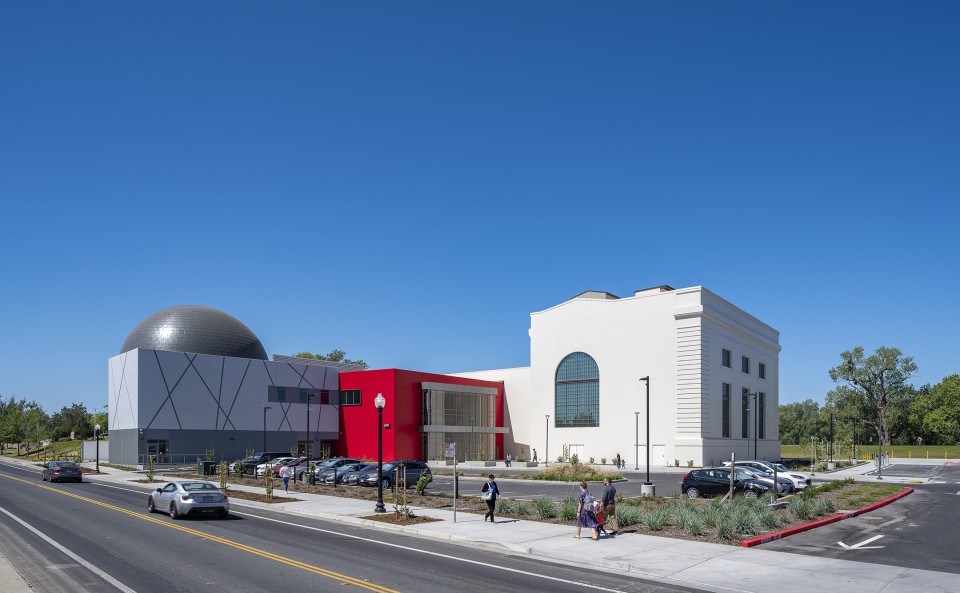
SMUD Museum of Science and Curiosity
Built in 1912 by PG&E, this historic landmark sits on the bank of the Sacramento River. Originally designed in the Beaux-Arts Classicism revival style, this structure was the largest steam turbine hydroelectric plant in the region making it the primary source of energy for the City of Sacramento. Throughout its lifetime, this building has seen three ownership changes, leaving it vacant at times throughout the years. In 2002, the City of Sacramento acquired the site and by 2009, the vision for a science center was born. In 2010, the building was listed on the National Historic Register.
In 2018 after years of being idle, this space was finally transformed into the SMUD Museum of Science and Curiosity or MOSAC, a dynamic epicenter for STEM (science, technology, engineering, and math) education complete with a planetarium. Additional features of MOSAC include interactive exhibits and programming to explore the wonders of STEM, a cafe, a museum shop, office space, classrooms, and a state-of-the-art 120-seat full dome theater. This highly-visible landmark can be seen in all its glory right off Interstate 5 and is now a staple in the Sacramento community.
The project entailed a seismic retrofit of the original building that required surgical precision to maintain the historic fabric of the interior space. Utilizing a combination of shotcrete and new steel framing to augment the existing structure, the project received a new floor level doubling the size of the original structure.
2023 SEAOCC EXCELLENCE IN STRUCTURAL ENGINEERING AWARDS WINNER
Retrofit/Alteration - Award of Excellence
 Design Firm:
Degenkolb
Project:
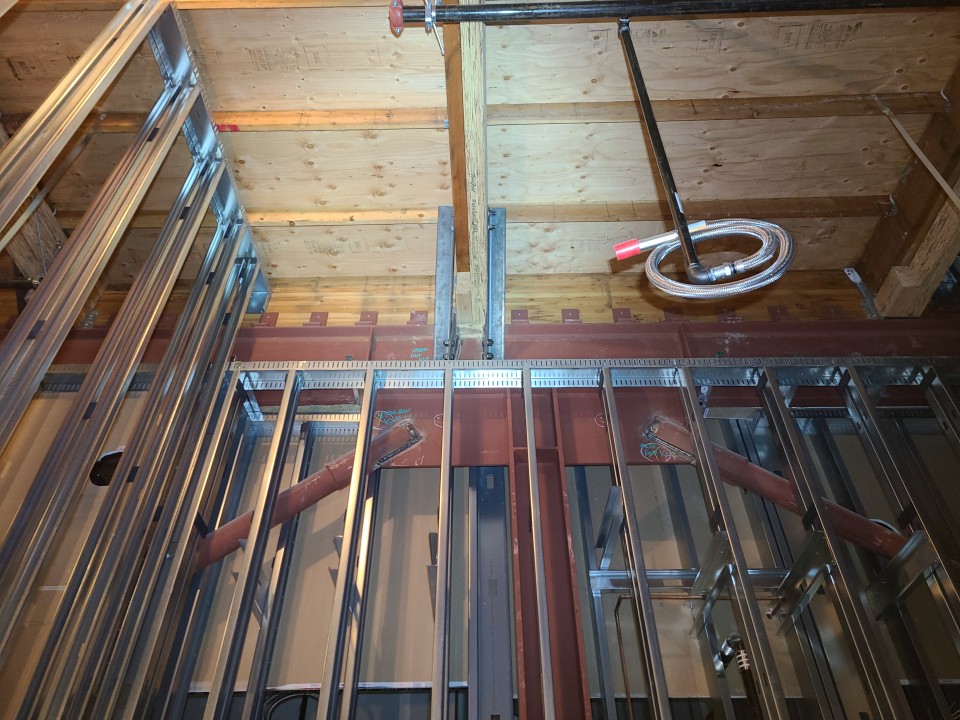
Mission Critical Datacenter
Degenkolb recently worked to upgrade an existing tilt-up concrete panel warehouse in Rocklin to a Mission Critical Datacenter. The project had a trifecta of challenges: A combined retrofit design and permit schedule of less than 3 months, a seismic retrofit of a vulnerable building to Immediate Occupancy performance, and a limited budget. Seismic strengthening of the building required creative solutions that maximized speed of construction rather than just designing to a demand-to-capacity ratio of 1.0. Unforeseen existing conditions resulted in an opportunity to collaboratively problem-solve under pressure from the aggressive schedule. Speed, technical acuity, communication, and flexibility were essential during this project.
2022 SEAOCC EXCELLENCE IN STRUCTURAL ENGINEERING AWARDS WINNER
Historic Preservation - Award of Excellence
 Design Firm:
Buehler
Project:
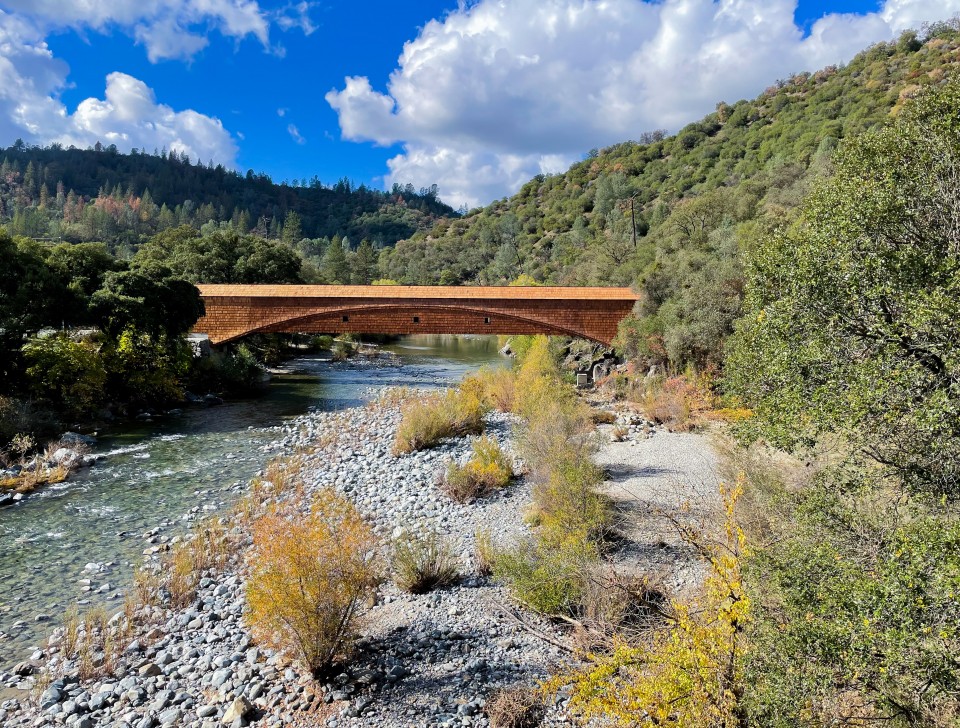
Bridgeport Covered Bridge
The Bridgeport Covered Bridge was constructed in 1862 by David Inglefield Wood of the Virginia Turnpike Company as a major toll road to support the development of the Comstock Silver Lode across the Sierra Nevada Mountains in western Nevada. The bridge has a substantial span of 208 feet over the South Fork of the Yuba River in Nevada County, California. The span has the distinction of being the longest remaining single - span wooden covered bridge in the world.
Buehler provided a full structural rehabilitation design of the bridge which both maintained the historical nature and detailing of the bridge while also making discrete structural improvements to allow the bridge to continue to be a historical resource for the State of California for many years to come.
The bridge is comprised of timber and iron with stone masonry abutments. The primary bridge structure utilizes a truss on either side of the floor deck which are flanked with a supplemental, segmented arch on the inside and outside face of each truss. The truss has an upper and lower chord with double braces and single counter-braces within the web. The vertical web members consist of two iron tension rods. The chords, braces, counter-braces, and tension rods are coincident at cast iron nodes. Damaged member replacement and maintenance were performed while also undergoing a complete gravity and lateral analysis with certain, discrete strength enhancements for better performance and longevity.
2022 SEAOCC EXCELLENCE IN STRUCTURAL ENGINEERING AWARDS WINNER
Historic Preservation - Award of Merit
 Design Firm:
Lionakis
Project:
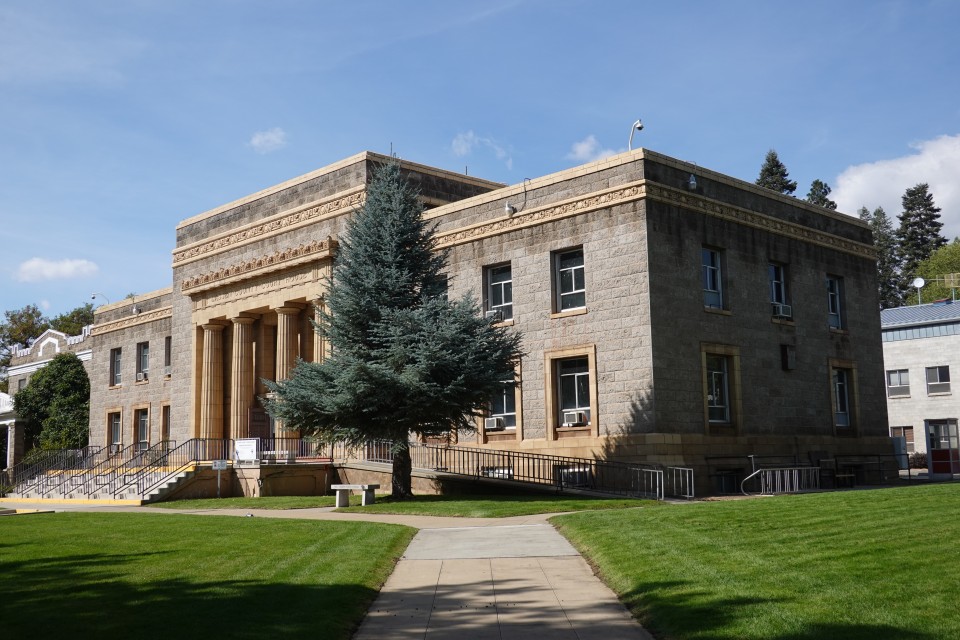
Historic Lassen County Courthouse Renovation
The Historic Lassen County Courthouse was originally built in 1917 and was listed on the National Register of Historic Places in 1998 due to its importance to the surrounding community, its architectural significance within the state of California, and the building’s classical revival design aesthetic. It was designed by California’s First State Architect and founder of our firm, George C. Sellon. Over 100 years later, the Lassen County Board of Supervisors seized an opportunity to renovate this historic building after the Superior Court of Lassen County moved to its new facility, which was also designed by Lionakis, in 2012.
The courthouse renovations include building and accessibility standards upgrades, seismic improvements, new elevator and exit stairs installed, and site access improvements. The historic courtroom within was converted into a meeting room for the city council. As an important legacy project for our firm, these improvements were led by Lionakis’ architects and structural engineers and were constructed by Broward Builders. Electrical service upgrades were provided by Glumac Consultants to bring the building up to current workplace standards and breathe new life into this aging facility.
Throughout the project, special care was taken to ensure all historic aspects of the interiors remained untouched with the help of the project’s historical consultant, Page & Turnbull, Inc. The team, through Matterport Incorporated, used LIDAR technology to create 3D “point cloud” scans of the building which allowed them to create 3D models to convey design concepts to the County. They now serve as a learning opportunity for the community and give insight into the building’s rich history. The Historic Courthouse currently houses county administrative offices and, with these recent structural renovations, will continue to serve the community for years to come.
2022 SEAOCC EXCELLENCE IN STRUCTURAL ENGINEERING AWARDS WINNER
Historic Preservation - Award of Merit
 Design Firm:
Miyamoto
Project:
Seismic Restoration and Repair od Gaddi Baithak
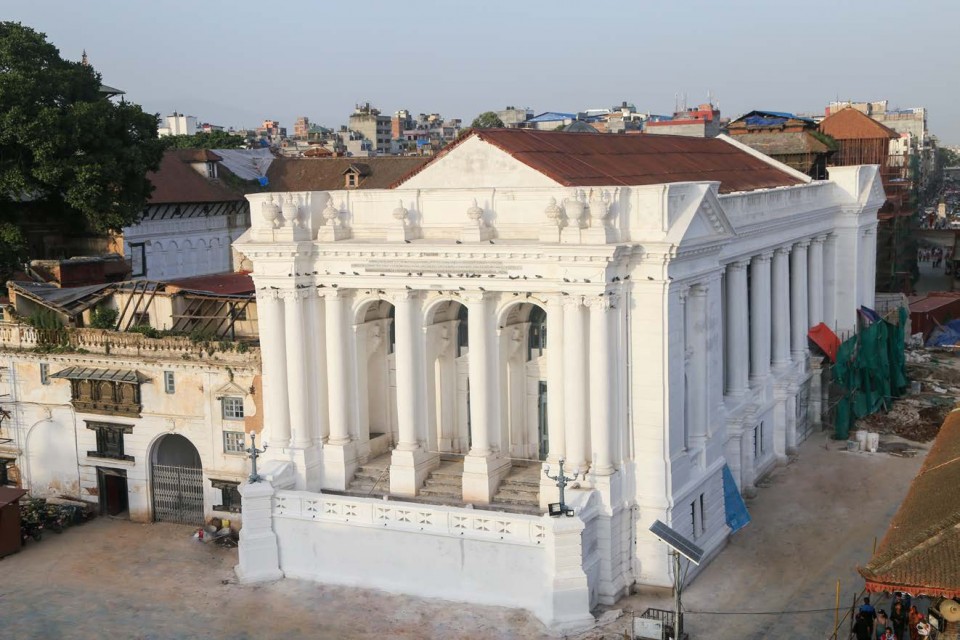
Miyamoto seismic experts in Nepal, Italy and the U.S. collaborated on engineering solutions after a 7.8 magnitude earthquake in 2015 severely damaged the Gaddi Baithak, a 100-year-old heritage palace at the UNESCO World Heritage site in Kathmandu Durbar Square. The scope included evaluating the damage and developing a technical plan to repair and seismically strengthen the palace building while also preserving its architectural significance by using traditional materials/methods. The team also oversaw the construction and facilitated ongoing coordination with government ministries and agencies, historic experts and other key stakeholders. The reconstruction effort—a model for defining engineering practices and methods for repairing neoclassical buildings in Nepal rather than demolishing them post-earthquake—is a world-class example of stakeholders working together with the goal of accurate, well-built reconstruction of important heritage buildings. The ambassadors’ fund generously funded the entire project.
2022 SEAOCC EXCELLENCE IN STRUCTURAL ENGINEERING AWARDS WINNER
New Construction - Award of Excellence
 Design Firm:
Buehler
Project:
1430 Q Street
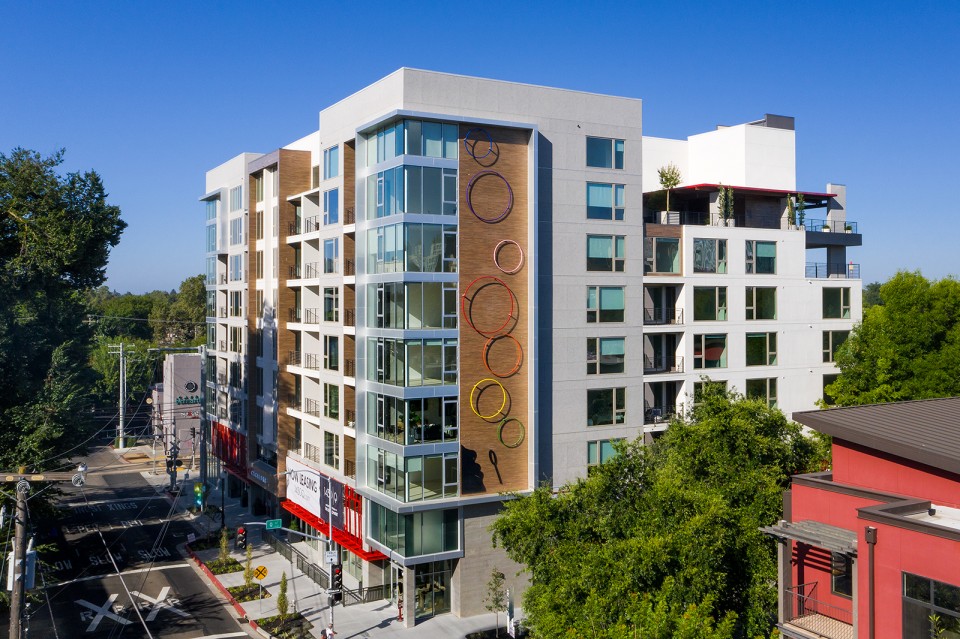
1430 Q Street, a mixed-use residential development in Sacramento, CA, is the first multi-family building in the United States to utilize six and one half stories of traditional wood-frame construction over a 2-story concrete podium. This project is one of many that symbolize the movement toward taller wood framed structures. This movement is bringing a significant shift in code regulations that permit the use of wood in very tall structures while also providing guidelines to assure for public safety.
The recently completed development has a total gross area of approximately 162,700 square feet. The first two levels above grade and the subterranean level are a concrete podium with parking and ground-level retail space. The upper six and one half levels are market-rate for-rent residential units. Since the overall building height exceeds code limits for Type III construction, the team addressed fire rating concerns with an Alternate Materials, Design and Methods of Construction Request (AMMR) which was submitted to and approved by the City of Sacramento. The wood-framed shear walls of the superstructure remained within the code height limitations by extending the concrete podium shear walls up one level into the wood framed construction. As the discontinuous concrete shear walls weave down through the parking and retail levels, designing for overturning resistance was a key consideration.
2022 SEAOCC EXCELLENCE IN STRUCTURAL ENGINEERING AWARDS WINNER
New Construction - Award of Excellence
 Design Firm:
Degenkolb
Project:
Mangini Ranch Elementary School
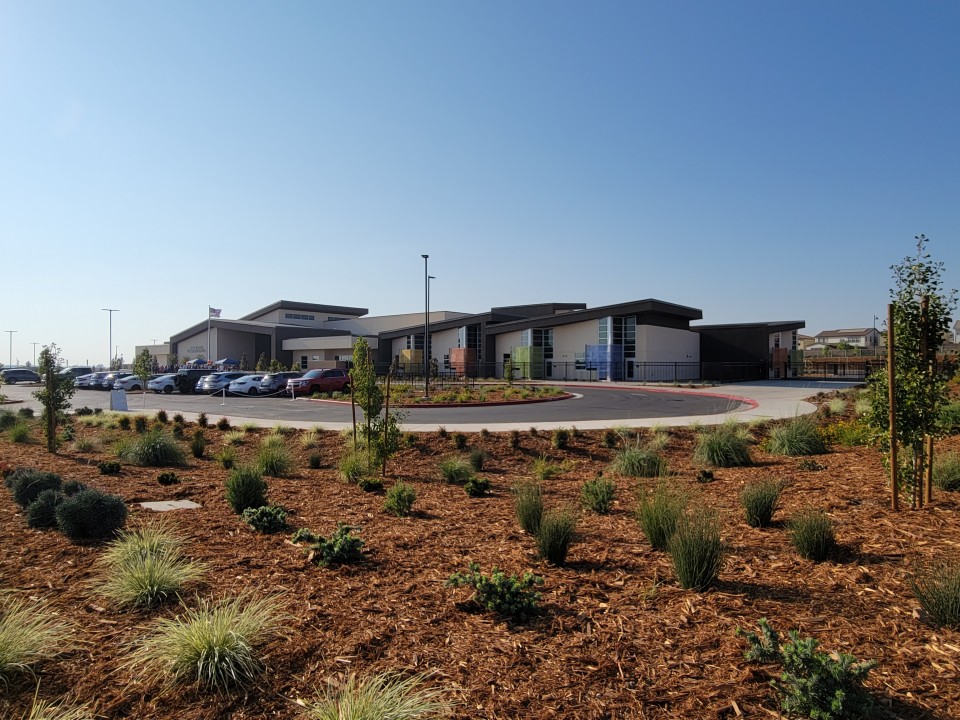
When Folsom Cordova Unified School District set out to build the new Mangini Ranch Elementary School, they had one core idea in mind: Flexibility. Flexibility in space, flexibility in technology, and flexibility in future uses and updates. The challenge became how to design a programmatically flexible building while also meeting the stringent seismic requirements for California schools. After several years of research, travel, and face-to-face interviews with schools across several states, the District Superintendent, the Design Architect, and key stakeholders decided the right solution to meet their needs was an all-encompassing, single-building elementary school serving Kindergarten through 5th Grade. Mangini Ranch Elementary School is the first of its kind for the Folsom Cordova Unified School District: a flexible building designed to provide a safe learning environment for now and in the future.
From a design perspective, the 75,000 square-foot campus functions as a single multi-story building, but is comprised of five detached structures. The separate areas are arranged for flexible spaces, improved energy efficiency, and enhanced security. Upon entering the building, students are greeted in the heart of the school: the Commons area. This two-story volume includes a grand staircase; Learning Resource Center; and access points to all student, multi-purpose, and administrative spaces. Classrooms are situated in clusters, and folding glass partition walls provide the opportunity to extend learning and collaboration beyond the classroom space.
The four primary buildings are of steel construction with special moment frame lateral force resisting system (LFRS). The second floor has a composite deck and the roofs are untopped steel deck. The exterior cladding system is comprised of cold-formed steel framing with flexible finishes. The fifth structure, an Outdoor Lab providing access between the two-story classroom wings and additional teaching space, is of cast-in-place concrete construction with a moment frame LFRS.
2022 SEAOCC EXCELLENCE IN STRUCTURAL ENGINEERING AWARDS WINNER
New Construction - Award of Merit
 Design Firm:
Lionakis
Project:
Sonora County Courthouse
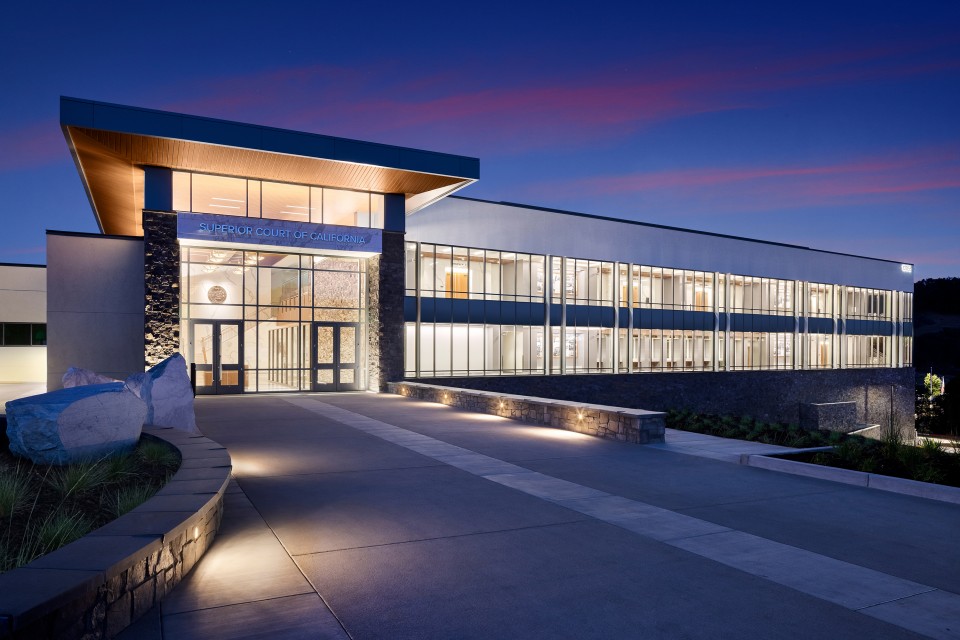
Tuolumne County’s Historic Sonora Courthouse, located in Courthouse Square in downtown Sonora, served the County residents for over a century. However, the Historic Sonora Courthouse outlived its capacity to support court operations. As a result, the County developed a master plan for a Law & Justice Center to collocate judicial and correctional services on an efficient and modern campus to better serve the community. The Tuolumne County Sonora Courthouse is now the centerpiece of this campus, adjacent to a new jail and juvenile hall.
The Courthouse is integrated into steep topography while providing scenic views of the surrounding Sonora hills. The stepped building pad provided an opportunity for the lower level to house important operational elements like secure parking for court officers, holding areas, and the building’s mechanical systems. The building is situated east/west and takes full advantage of daylight to leverage passive solar benefits. Within the Courthouse’s lower level, insulated masonry walls protected the interior spaces from the exposed areas, such as parking, to temperature swings.
Although the Courthouse is in a region with low seismicity, we utilized an efficient quantity of braced frames that provided the lateral force-resisting system. The braced frames are special concentrically braced frames which enabled us to keep seismic demand forces extremely low.
Lionakis is an Architecture/Engineering firm, therefore, we collaborated closely with our in-house Architects and with our great team of consulting engineers including ARUP for Mechanical, Plumbing, and Electrical Engineering throughout project design. Wallace-Kuhl and Associates, the Geotechnical Engineer, provided excellent support during design and construction. The design team also benefited from the experience and commitment from the General Contractor, Turner Construction.
2022 SEAOCC EXCELLENCE IN STRUCTURAL ENGINEERING AWARDS WINNER
People's Choice Award
Design Firm:
Degenkolb
Project:
Mangini Ranch Elementary School
When Folsom Cordova Unified School District set out to build the new Mangini Ranch Elementary School, they had one core idea in mind: Flexibility. Flexibility in space, flexibility in technology, and flexibility in future uses and updates. The challenge became how to design a programmatically flexible building while also meeting the stringent seismic requirements for California schools. After several years of research, travel, and face-to-face interviews with schools across several states, the District Superintendent, the Design Architect, and key stakeholders decided the right solution to meet their needs was an all-encompassing, single-building elementary school serving Kindergarten through 5th Grade. Mangini Ranch Elementary School is the first of its kind for the Folsom Cordova Unified School District: a flexible building designed to provide a safe learning environment for now and in the future.
From a design perspective, the 75,000 square-foot campus functions as a single multi-story building, but is comprised of five detached structures. The separate areas are arranged for flexible spaces, improved energy efficiency, and enhanced security. Upon entering the building, students are greeted in the heart of the school: the Commons area. This two-story volume includes a grand staircase; Learning Resource Center; and access points to all student, multi-purpose, and administrative spaces. Classrooms are situated in clusters, and folding glass partition walls provide the opportunity to extend learning and collaboration beyond the classroom space.
The four primary buildings are of steel construction with special moment frame lateral force resisting system (LFRS). The second floor has a composite deck and the roofs are untopped steel deck. The exterior cladding system is comprised of cold-formed steel framing with flexible finishes. The fifth structure, an Outdoor Lab providing access between the two-story classroom wings and additional teaching space, is of cast-in-place concrete construction with a moment frame LFRS.
2021 SEAOCC EXCELLENCE IN STRUCTURAL ENGINEERING AWARDS WINNER
New Construction - Award of Merit
 Design Firm:
Buehler
Project:
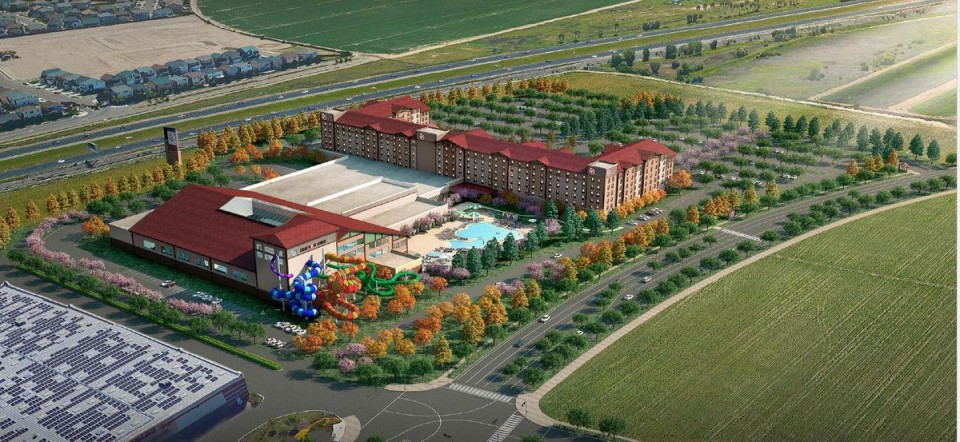
Great Wolf Resort, Manteca
The Great Wolf Lodge is the anchor of a master-planned entertainment district in the Manteca community. The resort includes a six-story, 500 key hotel and conference center, a 95,000 sf indoor water park, and a single-story Family Entertainment Center (FEC) that provides a continuous indoor link between the other two structures. These three distinct areas within the resort required different structural systems to meet project goals from the standpoints of both functionality and constructability.
To meet the aggressive construction schedule, precast concrete was an important component of all three structures. The hotel was constructed almost entirely of precast concrete, utilizing untopped, horizontal planks for the roof and floor supported by precast girders spanning to precast columns and bearing and shear walls. The FEC and water park also utilized perimeter precast bearing and shear walls with different roof systems. The FEC framing consisted of open web steel joists for the roof to minimize columns and maximize open space to accommodate features such as a bowling alley, mirror maze, and miniature golf course. The water park structure used long span steel trusses supporting a heavy timber roof with its exterior panels accommodating elevated waterslide penetrations.
Adherence to the Great Wolf brand was extremely important to the ownership group. Therefore, collaboration was imperative between Buehler (SEOR), Turner (General Contractor), Stantec (Architect of Record plus MEP design), Gensler (Design Architect), Clark Pacific and CTU (precast concrete trade partners), Geopier (foundation trade partner), and Great Wolf including Neuman Pools (specialty pool contractor) and a specialty theming consultant for the various attractions in the FEC and throughout the hotel. The level of coordination required between so many entities for this project made it challenging, yet rewarding upon its successful completion.
2021 SEAOCC EXCELLENCE IN STRUCTURAL ENGINEERING AWARDS WINNER
New Construction - Award of Excellence
 Design Firm:
TETER Architects and Engineers
Project:
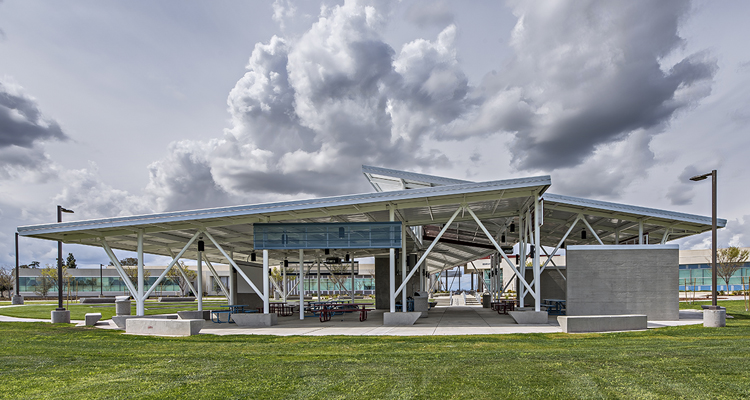
College of Sequoias Pavilion
This open-air structure was designd to meet multiple objectives. The student pavilion connects campus buildings, provides year-round, shaded shelter, establishes an entertainment space, encourages peer collaboration and allows for flexible teaching configurations. Architect Stan Canby says of the design, “The spacious and open structure engages its visitors, providing a different visual sense of being from all angles. In addition, the pavilion serves as a campus hub for the exchange of ideas and collaboration between members of the school community, encouraging cross-pollination across the College of the Sequoias’ student body."
2021 SEAOCC EXCELLENCE IN STRUCTURAL ENGINEERING AWARDS WINNER
Special Use Structures - Award of Excellence
Design Firm
Norman Scheel Structural Engineering
Project
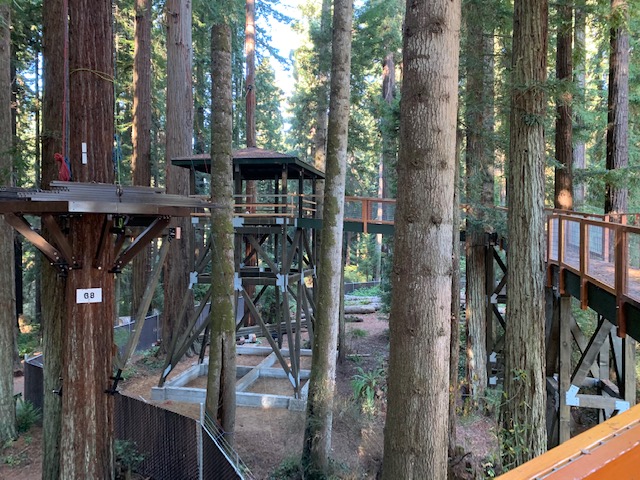
Sequoia Zoo Redwood Skywalk Structure
The Redwood Skywalk Project at Sequoia Park Zoo was developed to bring visitors into a place few people ever experience, halfway into an old growth redwood canopy. This project provides visitors an accessible, educational adventure where they learn about the redwood forest and its natural history and wildlife in a one-of-a-kind elevated path that is over 1000 feet long and 100 feet off the forest floor.
The journey begins with a timber framed Ascent Ramp, designed to be reminiscent of a historic redwood train trestle. The construction was framed with large structural Douglas fir columns, spanned by large beams and topped with pultruded decking, redwood and metal mesh panels. The Ascent Ramp zig zags through the redwoods while providing an accessible path of travel for all visitors where it terminates at the Launchdeck, a 350 s.f. timber framed structure designed to evoke historical fire lookouts built in the 30s by the Civilian Conservation Corps. The Launchdeck was built with large dimension structural fir, poured in place deep piers and grade beams. The Ascent Ramp and Launchdeck are the gateways to the Skywalk, a 600- foot-long series of platforms and bridges, that are attached to large 2nd growth redwoods, with accessible flat bridges and adventure catenary bridges.
The project is the culmination of 5 years of hard work by a multi-disciplinary team of funders, City staff, engineering and architectural teams and a design build construction.
2021 SEAOCC EXCELLENCE IN STRUCTURAL ENGINEERING AWARDS WINNER
Retrofit/Alteration - Award of Excellence
Design Firm
Degenkolb Engineers
Project
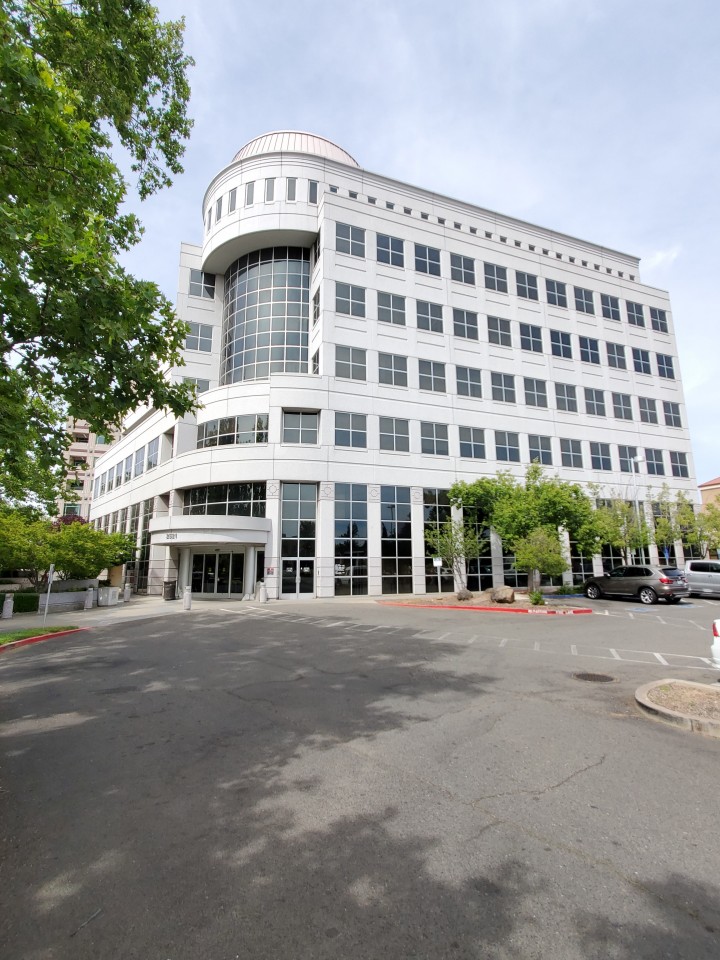
UC Davis Health Glassrock Building Advanced Analysis
Beginning in 2017 the University of California Office of the President (UCOP) implemented an updated seismic safety policy. This charges each campus with evaluating existing facilities for compliance with seismic safety criteria. As part of that effort, Degenkolb Engineers was asked to evaluate the Glassrock Building located near the UC Davis Health campus in Sacramento, CA. The seven-story steel moment-frame building was constructed in 1994. Its beam-column connections use welding procedures typical of that time, which are vulnerable to fracture in large earthquakes. Fracture of a beam-column connection could result in at least partial collapse. Experience suggested that using simple linear analyses to evaluate the connections would result in failure to meet acceptance criteria—but that this result would be unnecessarily conservative. Consequently, the Glassrock Building was a good candidate for nonlinear response history analysis and careful review of any fractures of beam-column connections. The nonlinear analysis showed that despite the potential for limited brittle connection behavior, the beam-to-column connections would maintain gravity support, and the existing building was capable of meeting UCOP Seismic Performance Criteria. In this case, the additional effort required to carefully assess the performance of the moment frame connections avoided the need to retrofit the structure. Specific recommendations were developed to facilitate a post-earthquake condition assessment of the connections most likely to experience fracture.
Devon Lumbard was the principal-in-charge; Bob Pekelnicky was the project advisor; and Michael Chisholm and Daniel Miller were project engineers.
2021 SEAOCC EXCELLENCE IN STRUCTURAL ENGINEERING AWARDS WINNER
Retrofit/Alteration - Award of Excellence
Design Firm
Buehler
Project
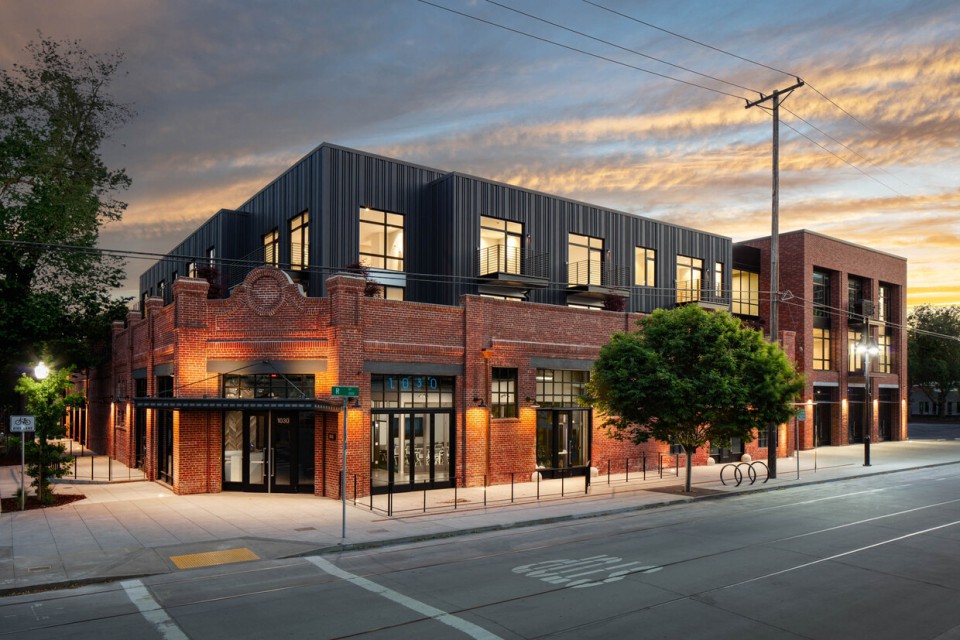
The Carlaw - 11th and R Street Renovation
The Carlaw is an adaptive reuse of an existing 100 year old single-story URM (un-reinforced masonry) building at the SW corner of 11th and R Streets in downtown Sacramento. The project includes two upper levels of residential over ground level retail or office space. The two levels of housing will be comprised of 26 residential units, 30,000 square feet in total. The residential portion are market rate units. The ground level mixed-use retail/office will have a gross area of 17, 200 square feet, for a total project area of approximately 47,200 square feet.
Although not on the historic register, the design of the building required approval by the City of Sacramento Historic Preservation. The existing structure is comprised of an eastern and western portion and appears to date from the 1920s. The existing roof did not provide a viable structural support for the two additional housing levels. So, the existing roof within this building was demolished and exterior portions of the existing URM walls remained and were modified/strengthened, as needed, based on the new architectural façade. Temporary bracing for the walls was provided during construction. New openings were provided in the URM walls using steel perimeter frames at the north, east, and south elevations.
Due to potential liquefaction of deeper on-site soils, the building is supported on a combination of new helical steel piles and auger cast concrete piles with pile caps for the columns and grade beams for the shear walls. The concrete slab on grade was placed over a treated subgrade section and “liquid boot” to seal off hazardous soil on the site. The building was once a printing facility and had contaminated the soil within the building.
2020 SEAOCC EXCELLENCE IN STRUCTURAL ENGINEERING AWARDS WINNER
New Construction
 Design Firm:
Lionakis
Project:
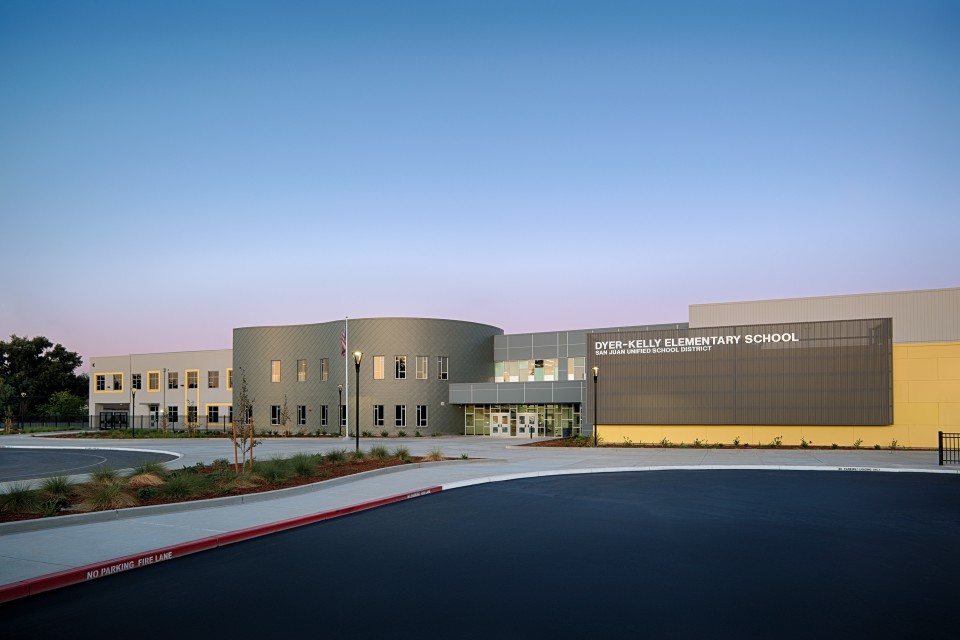
Dyer-Kelly Elementary School Replacement Campus, San Juan Unified School District
This project boasts a low budget, 16-month construction completion of the new two-story 75,750 square foot single building
replaced the existing Dyer-Kelly Elementary School campus to serve students in an underserved community. The project was
design-build with a total construction cost of $35 million. Some of the notable aspects of this project include:
- The requirement of a robust construction phasing and safety plan due to the project site being adjacent to the existing campus buildings.
-
Creating the entire campus in a single building footprint required consideration for a future expansion. Requiring a seismic separation for one wing of the main structure to allow the flexibility for future expansion.
Housing all the function of the entire elementary school campus within a single building also presented the challenge of choice of structural system. The design includes a large amphitheater, high-volume spaces required for the multi-purpose and foodservice areas. As a result, the structural system selected was steel framing with prefabricated exterior wall panels to minimize on-site construction time. The lateral resisting system was Side-plate moment frames with columns embedded in grade beams for fixity and reduced inter-story drift with optimum space flexibility in primary spaces, cold-formed shear walls to accommodate high volume multi-purpose spaces, and strategically placed seismic gaps for easy accommodation of future expansion.
The exterior cladding system was also designed with minimizing construction time, construction cost, and safety concerns in mind. The design consisted of two-story wall panels to be fabricated at the contractor’s shop facility. The modular window configuration specifically sized to lay flat on a delivery truck and be quickly attached to the structure with bypass framing clips. This off-site prefabrication successfully minimized construction time, saved construction dollars and reduced some of the safety concerns associated with construction on an occupied elementary school campus.
2020 SEAOCC EXCELLENCE IN STRUCTURAL ENGINEERING AWARDS WINNER
Retrofit/Alteration
 Design Firm:
Buehler
Project:
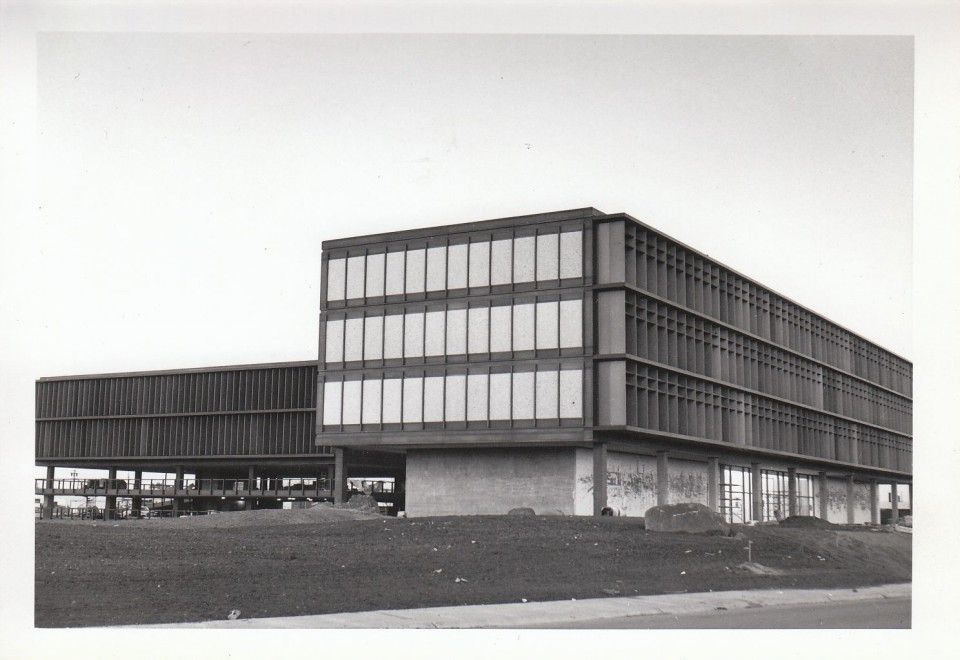
SMUD Headquarters Seismic Retrofit
This project was awarded for their innovative design and mitigation strategy for seismically retrofitting the SMUD Headquarters building to a higher performance level than code mandated minimums. The building is on the National Register of Historic Places and the rehabilitation was designed to comply with the “Secretary of the Interior’s Standards for the Treatment of Historic Properties, Standards for Rehabilitation." The mitigation strategy for the building had the following main objectives:
- Mitigate the structural deficiencies of the building to extend the useful life of the strucutrue to that equivalent to a new structure
- integrate the retrofit to preserve the building configuration and historic exterior facade
The Performance Objective selected for the SMUD Headquarters South Wing and Core building was the Basic Performance Objective Equivalent to New Building Standards (BPON). Integration of the California Historic Building Code (CHBC) was utilized on a case-by-case basis as required to balance the required structural performance with the desired historic preservation. The retrofit was a voluntary seismic upgrade, but it triggered mandatory seismic strengthening of certain elements of the load path because of an addition to the core area of the building. The lateral force resisting system of the existing building consisted of open web joist steel moment frames. The retrofit strategy included:
- Incorporation of fluid viscous dampers to reduce building drift and protect the historic fabric
- Improving the performance of the open web truss beam-column joints via truss chord/web and column/web strengthening
- Robust interconnection of the building’s south wing to two new multi-story moment frames within the building’s core
- Strengthening of the lightweight concrete over metal deck diaphragms with fiber reinforced polymer (FRP) at the highest stressed areas to aid in force transfer to the new core moment frames.
2019 SEAOCC EXCELLENCE IN STRUCTURAL ENGINEERING AWARDS WINNER
New Construction
Design Firm:
Buehler
Project:
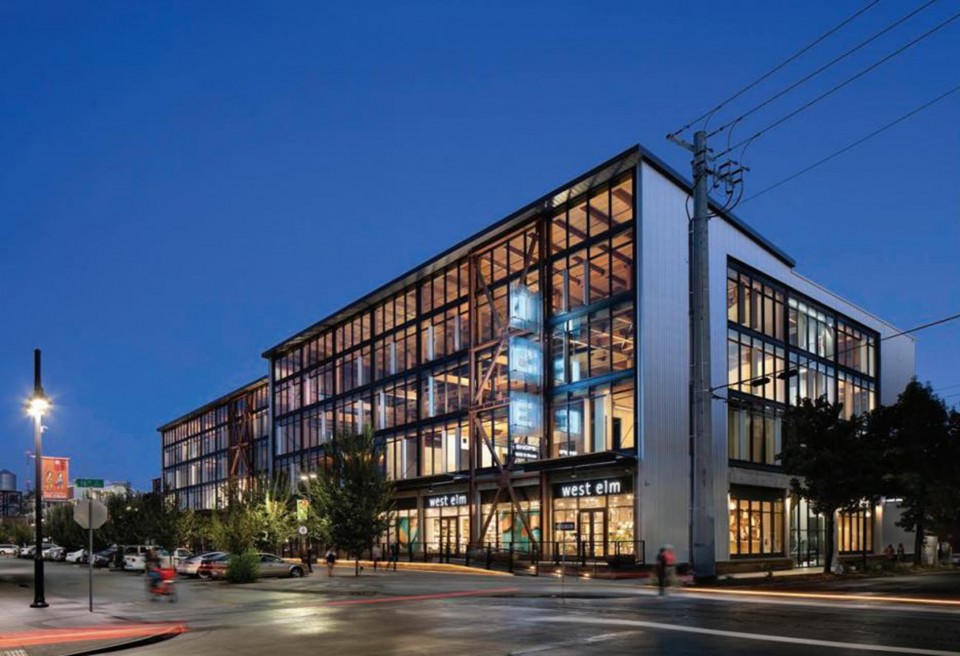
Ice Block 1
ICE Block I is one of the first projects in Northern California to utilize an exposed heavy timber structure. The building blends three structural materials in a seamless and revealing fashion, with heavy timber upper floors supported by a concrete podium at the second floor, and steel Buckling Restrained Braced Frames (BRBFs) for the lateral system.
The glulam post and beam system of the upper levels uses a cantilevered girder over the columns as opposed to a traditional simple span girder. This allowed for a reduction in girder depth to make it commensurate with the beam depths. The glulam beams connect to the girders and columns with custom steel saddle hangers and column caps. Solid sawn 3x decking with a non-structural concrete topping round out the floor system at the wood levels. The fourth floor is the crown jewel of the architecture, with the north and south edge of the floor pulled back from the exterior wall to create a two-story volume, which allows tenants a vertical connection through the 30-foot-tall space.
The concrete second floor is a one-way reinforced concrete slab supported by post-tensioned girders. The girders in the second floor serve as a transfer girder to transition the column spacing of the wood levels to a grid appropriate for drive aisles in the basement parking level. The second floor was chosen for the transfer girder level because there was ample height clearance at level 1, which allowed the garage level to be as shallow as possible to minimize excavation depth.
The BRBFs strategically exposed on the exterior of the building on the north and south sides express the structural elements as an architectural feature and provided a unique engineering challenge to deliver the lateral forces to the frame. On the east and west ends, the BRBF is encased in the concrete columns and beams. The BRBF system transfers its forces to the concrete shear wall system of the basement walls at the first-floor level through large embedded steel plates in the tops of the concrete columns.
The nearly identical east and west wings are connected by a sky bridge at the second through fourth floors, which is seismically isolated at one end. The first-floor exterior deck area is elevated 30 inches from the adjacent sidewalk grade to create a pedestrian area for retail and restaurant use.
2019 SEAOCC EXCELLENCE IN STRUCTURAL ENGINEERING AWARDS WINNER
Retrofit/Alteration
Design Firm:
Barrish Pelham, A Degenkolb Company
Project:
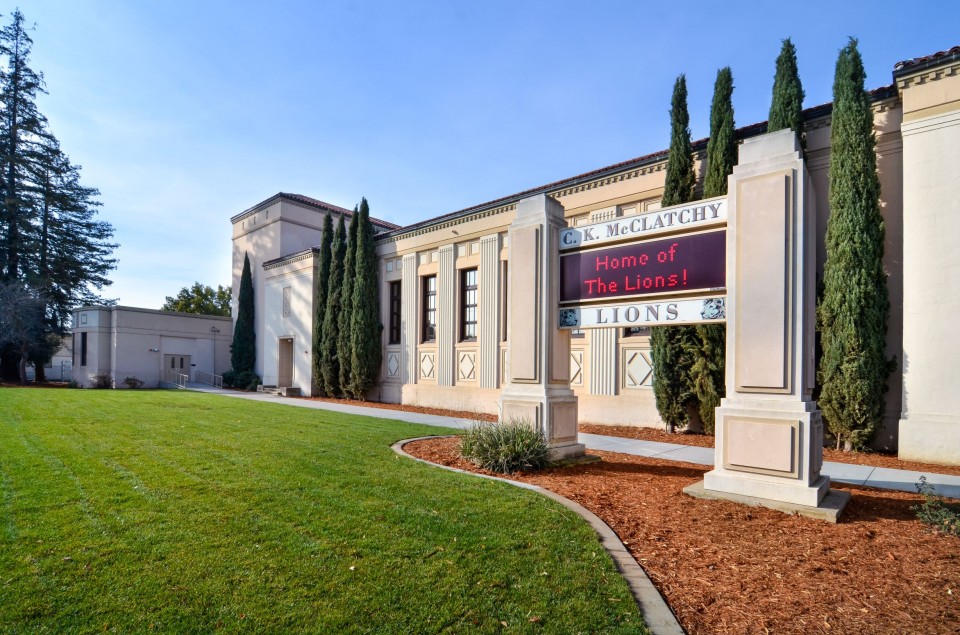
C.K. McClatchy High School Visual & Performing Arts Modernization
Barrish Pelham, a Degenkolb Company (Barrish Pelham), provided the structural design for the modernization of the historic C.K. McClatchy High School’s Visual and Performing Arts (VAPA) building. The existing 1930s-era, 850-seat theater and associated spaces—including a black box classroom, dressing area, 3D art/scenes shop, photography classroom, band room, ceramics lab, and digital media classroom—all required significant upgrades for a modern learning environment. The $15.0M project modernized more than 31,000 square-feet of the existing building’s VAPA wing comprised of cast-in-place concrete walls, raised concrete floors, and wood-framed roofs. All work took place to the single-story portions of the attached two-story main building.
In 2002, the school was officially listed on the National Register of Historic Places, which made preserving the building’s original details essential to the modernization. The historic renovation of the campus’ performing arts venue and associated classrooms maintained many of the unique features of the original 1937 building, including Spanish-tile roofing, stained glass windows, a vaulted ceiling structure in the theater, and metal caps at the ends of each row of audience chairs.
The building has an irregular footprint with more than 120,000 square feet of area with intermixed single and two-story portions. The irregular building is entirely connected without any seismic joints. All impacts to the existing concrete shear walls and floor diaphragms needed to be identified and addressed. The design team used a Building Information Model (BIM) to build it from the ground up, including HVAC in the roof, crawlspace, and underground as well as the electrical runs throughout the historic structure. Barrish Pelham strived to maintain as much as of the existing roof as possible. This required modifying dead loads at existing steel trusses to allow for an increase in live loads.
The modernization process focused on retaining existing systems as much as feasible. Preserving the stage’s headblock beam, original theater’s riveted roof trusses, and re-using original cast-in anchors where possible are some examples of sustaining its history and reducing the overall impact.
2018 SEAOCC EXCELLENCE IN STRUCTURAL ENGINEERING AWARDS WINNER
New Construction
 Design Firm:
Buehler & Buehler Structural Engineers Inc.
Project:
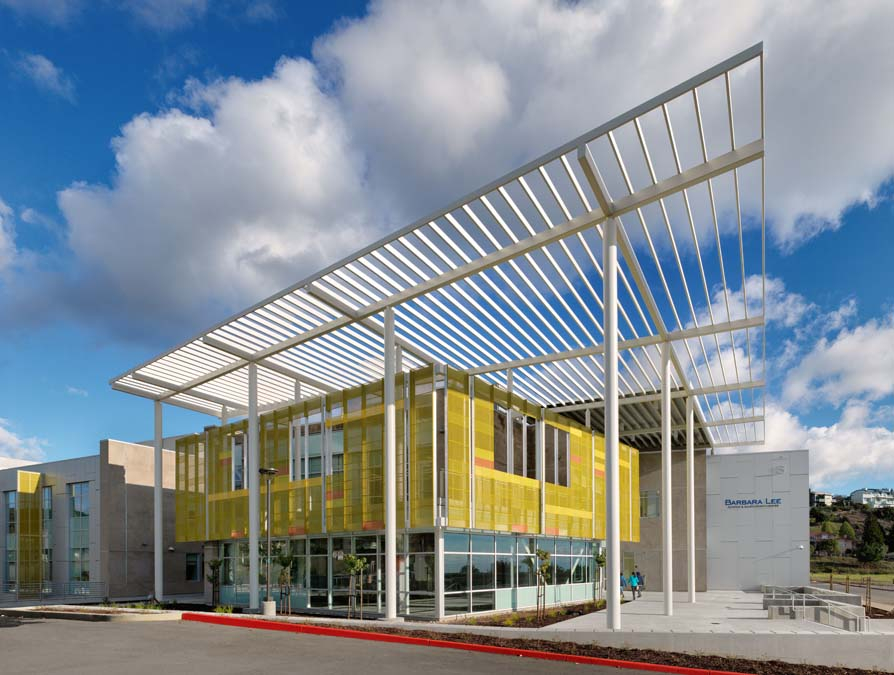
MERRITT COLLEGE SCIENCE AND ALLIED HEALTH BUILDING
This Project overcame several large challenges, any one of which could have kept the project from being built. These challenges created an opportunity for structural engineers to positively impact the project.Some of the project challenges included:
-
Extremely high seismic design forces due to close proximity (2km) to the Hayward Fault, an Sds 1.9 was used.
-
A dramatically sloping site; more than 20 feet across the entire length.
-
Rigorous and challenging plan review process with DSA Oakland.
-
Tight project schedule which necessitated early bid packages and material buyouts.
Our Engineering team designed an innovative structural system to meet the extreme needs of the project. The gravity system consisted of composite concrete and metal deck over steel beams and steel columns. The core feature was the lateral system: a high performance Buckling Restrained Brace System (BRBF) to reduce demands on the foundations and therefore significantly reduce costs. With this system we could also provide early buyouts, validate costs and meet the schedule. Our design concept enabled us to deliver the project under budget by $1.5 million and on time.
The basic building organization consists of a series of student-centered learning neighborhoods centered around high-tech specialized laboratory wings supported by shared-use general classrooms on each of the building’s four stories. Given the significant slope of the existing site, three of the four stories of the building have direct access to grade. With this connectivity opportunity, the learning neighborhoods have become places of invitation and engagement between the facility and the campus. The aesthetics of the architecture reinforces the curriculum. The success of the Center has created an educational and social experience that will continue to challenge, inspire and create the new heart and energy the campus and community desired.
2018 SEAOCC EXCELLENCE IN STRUCTURAL ENGINEERING AWARDS WINNER
Historic Preservation

Design Firm:
CYS Structural Engineers, Inc.
Project:
Carson Block Building
The rehabilitation of the stately, 19th-century Carson Block Building included a seismic retrofit and restoration of several interior and exterior features. The project revived one of Eureka’s first commercial buildings and reignited a communal pride in the city’s National Register-listed Historic District. The 50,000 SF building was built mostly of redwood with terra-cotta panels, brick arches, cast iron columns, and a tall redwood storefront. Boasting Richardson Romanesque features, a style indicative of east coast refinement, the building was initially a stark contrast to structures that populated Eureka, then still a frontier town. The Carson Block Building also contained the luxurious 1,400 seat Ingomar Theater, one of the first in the region. Key structural elements of the project included:
-
Providing strong and stiff lateral force elements behind the all glass south and west walls, that are not visible while preserving the historic fabric in those areas;
-
Stabilizing the full-height north and east masonry walls of the theater;
-
Restoring stability for the north end of the west wall that had been compromised by previous remodeling projects; and
-
Providing a Risk Category III Level renovation design for portions of the building to be occupied during the performances at the future theater.
2018 SEAOCC EXCELLENCE IN STRUCTURAL ENGINEERING AWARDS WINNER
Special-Use Structures

Design Firm:
NSSE
Project:
Our H2Ouse - Zero Net Energy House
California has experienced the state's hottest drought years on record within these past 10 years. As a result, many of the state's unsustainable water and energy use practices within urban and rural areas have been brought to light and calls for increased water and energy efficiency have been initiated by the state government, such as the 2014 Sustainable Groundwater Management Act (SGMA) and 2030 Climate Commitment. Based on an analysis of the social, political, economic, and environmental factors involved in the most recent California drought, it was determined that the state can increase its water and energy resilience by fostering a robust, conjunctive management of resources. Such a system aims to increase the general knowledge and sharing of collective as well as individual resource consumption data.
Our H2Ouse demonstrates that greater level of efficiency can be achieved by making the occupants of home the author of their own conservation experience. They will be made aware of their individual water usage in the house and educated in ways to reduce water use whenever possible.
Methods of energy and water saving were implemented from the project outset. Simply by designing smaller, more efficient structures, the building would have inherent water and energy savings. Therefore, the building envelope of the home was designed to be compact, and better insulated than standard framing methods. Additionally, the exterior design of the house and any irrigated plant life on the property will be entirely supported by what the occupants in the house have already used.
2018 SEAOCC EXCELLENCE IN STRUCTURAL ENGINEERING AWARDS WINNER
New Construction - Award of Merit

Design Firm:
Lionakis
Project:
Foothill College Sunnyvale Center
Located in the heart of Silicon Valley, the new Sunnyvale Education Center represents the first campus extension building to support Foothill College in the Foothill-De Anza Community College District. Serving as the redevelopment of the former Onizuka Air Force Station, the building is two stories with a 46,991 square foot floor plan. The east and west wings house classroom and faculty offices and are connected by a central entry core with student resources, gathering spaces, and a coffee shop. The east wing of the building features sweeping roof line curves and open glazing, while the west wing features a more prominent geometry and finishes similar to the Onizuka Air Force Station structures on site.
The structure is steel framed with concrete filled steel floor decks throughout the building. The eastern classroom wing departs from the west wing roof with a radiused high roof deck over an open corridor with exposed roof framing and braced frames spanning across a continuous openings in the main roof deck. The Seismic Force Resisting System for the structure is special concentric steel brace frames utilizing unique in-plane buckling design for the plastic hinge region of the gusset plates.
The foundation of the structure is a two foot thick concrete mat slab under the entire footprint. Prior to constructing the mat slab, a 10 foot high uniform stock-pile of base concrete material, recycled on-site from the demolition of an existing parking garage, was built over the future foundation footprint of the building and monitored until soil settlement had stabilized. This sustainable approach removed costly driven piles from the design.
The Foothill College Sunnyvale Center has set the bar for future development on this expansion campus through a collaborative approach to sustainable practices across all disciplines, including an efficient yet robust structural design.
HIGHLIGHTED PROJECTS
Do you have a challenging, unique, or otherwise interesting design or research project that you would like to share with the SEAOCC community? We are always interested in hearing about the ways our member firms and organizations are advancing the practice of structural engineering! Head on over to the Excellence in Structural Engineering Awards to see how your project can be featured on the website! Please contact the SEAOCC office with questions.


